1
Model the behavior
With permission, record the work. Capture decisions and learning. Show leaders what becomes possible when knowledge is intentionally preserved.
AI is changing what school systems can do—not just what individual employees can do. K12 Focus helps leaders make the information their district already creates easier to find, understand, and use. From there, districts can capture important knowledge and experience, learn from what they already know, and put that knowledge to work across the organization.
The work starts with leadership. Start small. Model the behavior. Use real district problems. Then scale what works.
A superintendent does not need another abstract AI presentation. School finance is a practical example of a challenge every superintendent faces: quickly finding the right information when you need it. Try the assistant, then imagine the same capability built from your own district information.
School finance is a good example of a larger challenge: organizations often have plenty of information, but accessing and using it can be difficult. The School Finance Assistant shows how AI can reduce that friction. Ask it a real Kansas school-finance question, then imagine applying the same concept to the knowledge already inside your district.
Then make the mental leap: What if your own board meetings, policies, procedures, leadership notes, curriculum, and institutional knowledge worked the same way?
Access note: These assistants are hosted with Google tools and may require you to sign in with a Google account. Some school-managed Google accounts may restrict access to externally shared resources; if that happens, try a personal Google account.
K12 Focus uses a simple framework to help leaders see that an “AI assistant” can do very different jobs inside a school system.
Make trusted policies, procedures, standards, meeting knowledge, guidance, and other approved information easier to find and use.
Preserve stories, lessons learned, decision context, practical wisdom, and knowledge that can disappear when experienced employees leave.
Use knowledge and experience interactively to help someone think through a situation, consider options, and identify a practical next step.
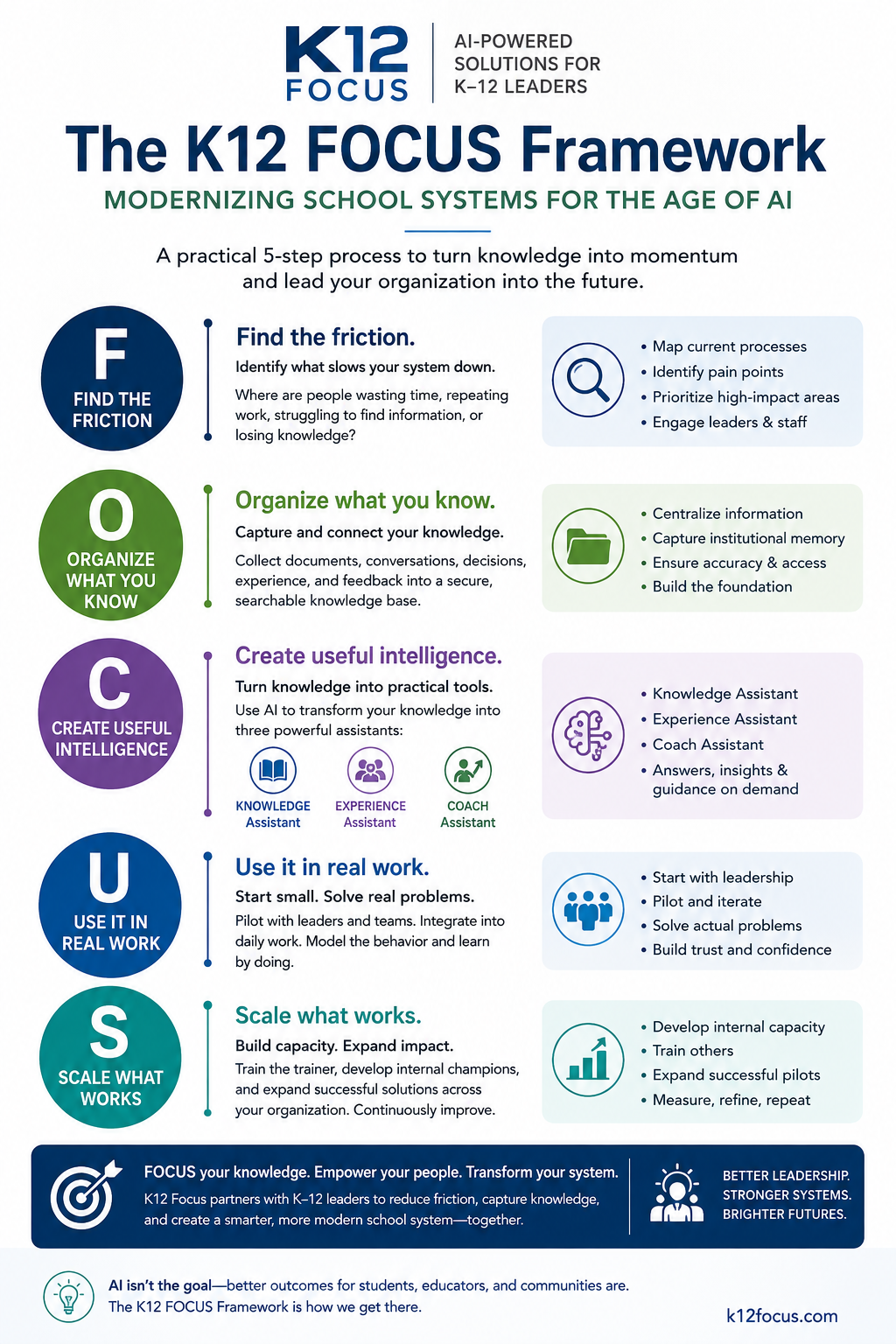
FOCUS is not a technology rollout. It is a leadership process for deciding what deserves attention, capturing what the organization knows, using AI where it creates real value, and expanding deliberately.
Identify repeated work, delays, hard-to-find information, lost knowledge, and processes that frustrate people.
Capture and connect documents, meetings, decisions, feedback, expertise, and institutional memory.
Turn trusted knowledge into useful assistants, summaries, insights, and decision support.
Start with leaders and employees. Pilot on actual problems. Model the behavior and learn by doing.
Develop internal champions, train the trainer, expand successful pilots, and keep improving.
The easiest way to make AI another abandoned initiative is to start too big. K12 Focus begins with a superintendent and a small leadership group, builds shared understanding, and creates one or two visible wins before expanding.
With permission, record the work. Capture decisions and learning. Show leaders what becomes possible when knowledge is intentionally preserved.
Use open-ended surveys, reflections, and conversations. AI makes it practical to analyze qualitative feedback at a scale that used to be burdensome.
Choose one internal need, create something useful, test it with real employees, learn from the results, and decide what deserves to scale.
Start where your district is. Learn enough to lead responsibly, discover where organizational value exists, and improve one practical area at a time.
Practical professional learning for leaders, educators, and school employees who need a useful foundation in responsible AI use.
Leadership in the Age of AI helps a small administrative team understand what is now possible, examine friction and organizational knowledge, and identify realistic opportunities.
Use the FOCUS framework to choose a real problem, gather better information, create a practical pilot, and build local capacity around what works.
Leadership, organizational learning, reducing friction, capturing knowledge, preserving experience, using employee feedback, developing AI assistants, building repeatable internal habits, and helping leaders turn new capabilities into better systems.
Student AI rules, classroom AI policy, academic integrity, curriculum adoption, and detailed instructional practice all matter. K12 Focus can discuss them, but this leadership work concentrates on how the organization itself learns and improves.
K12 Focus is shaped by decades of teaching, technology leadership, system building, and a recent return to the classroom during the rise of generative AI.
Tom Sextro began as a math and computer science teacher, spent 28 years leading K–12 technology work, and later returned to the classroom. His focus is turning complicated technology into practical leadership steps school systems can actually use.
You do not need a districtwide AI initiative. Start with a small leadership group, experience what is possible, identify one source of friction or knowledge worth addressing, and decide what to do next.